Graham Healy call for a Double Dissolution and the removal of the Albanese government
- Graham Healy

- 4 minutes ago
- 5 min read
Graham Healy call for a Double Dissolution and the removal of the Albanese government I prophetically call this into being as of TODAY ! Graham Healy Tue 28 /7/26 **Double dissolution and a vote of no confidence are distinct constitutional and parliamentary mechanisms in Australia. Neither is a simple tool for an opposition or public to unilaterally “remove” a government.** A double dissolution resolves legislative deadlocks between the House of Representatives and Senate; it is initiated on the advice of the Prime Minister. A successful vote of no confidence in the House can force a government to resign or advise an election if it loses the confidence of the lower house.
### Legal pathways (clear table)

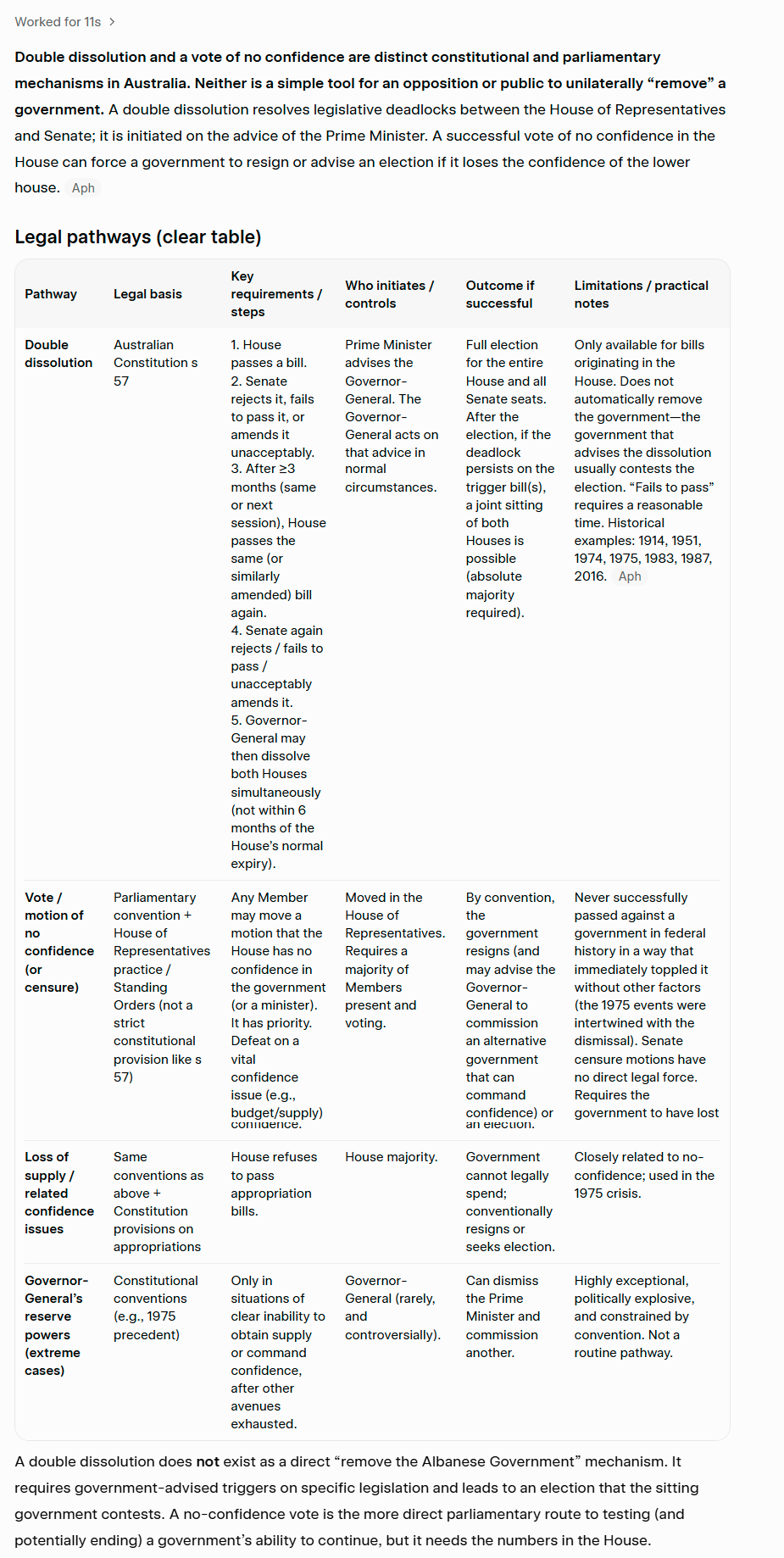
| Pathway | Legal basis | Key requirements / steps | Who initiates / controls | Outcome if successful | Limitations / practical notes |
|---------|-------------|---------------------------|---------------------------|-----------------------|-------------------------------|
| **Double dissolution** | Australian Constitution s 57 | 1. House passes a bill.<br>2. Senate rejects it, fails to pass it, or amends it unacceptably.<br>3. After ≥3 months (same or next session), House passes the same (or similarly amended) bill again.<br>4. Senate again rejects / fails to pass / unacceptably amends it.<br>5. Governor-General may then dissolve both Houses simultaneously (not within 6 months of the House’s normal expiry). | Prime Minister advises the Governor-General. The Governor-General acts on that advice in normal circumstances. | Full election for the entire House and all Senate seats. After the election, if the deadlock persists on the trigger bill(s), a joint sitting of both Houses is possible (absolute majority required). | Only available for bills originating in the House. Does not automatically remove the government—the government that advises the dissolution usually contests the election. “Fails to pass” requires a reasonable time. Historical examples: 1914, 1951, 1974, 1975, 1983, 1987, 2016. |
| **Vote / motion of no confidence (or censure)** | Parliamentary convention + House of Representatives practice / Standing Orders (not a strict constitutional provision like s 57) | Any Member may move a motion that the House has no confidence in the government (or a minister). It has priority. Defeat on a vital confidence issue (e.g., budget/supply) can also demonstrate loss of confidence. | Moved in the House of Representatives. Requires a majority of Members present and voting. | By convention, the government resigns (and may advise the Governor-General to commission an alternative government that can command confidence) or advises dissolution of the House for an election. | Never successfully passed against a government in federal history in a way that immediately toppled it without other factors (the 1975 events were intertwined with the dismissal). Senate censure motions have no direct legal force. Requires the government to have lost its House majority (or crossbench support on confidence). |
| **Loss of supply / related confidence issues** | Same conventions as above + Constitution provisions on appropriations | House refuses to pass appropriation bills. | House majority. | Government cannot legally spend; conventionally resigns or seeks election. | Closely related to no-confidence; used in the 1975 crisis. |
| **Governor-General’s reserve powers (extreme cases)** | Constitutional conventions (e.g., 1975 precedent) | Only in situations of clear inability to obtain supply or command confidence, after other avenues exhausted. | Governor-General (rarely, and controversially). | Can dismiss the Prime Minister and commission another. | Highly exceptional, politically explosive, and constrained by convention. Not a routine pathway. |
A double dissolution does **not** exist as a direct “remove the Albanese Government” mechanism. It requires government-advised triggers on specific legislation and leads to an election that the sitting government contests. A no-confidence vote is the more direct parliamentary route to testing (and potentially ending) a government’s ability to continue, but it needs the numbers in the House.
### Practical example of a recent terror attack and government response
In December 2025 a father-and-son pair carried out a shooting attack at Bondi Beach during a Jewish community event (Hanukkah), killing 15 people. Authorities linked the attackers to Islamic State ideology.
The Albanese Government’s response included:
- Immediate condemnation, national security briefings, and coordination with New South Wales authorities.
- An urgent review of intelligence and agency effectiveness (former ASIO head Dennis Richardson appointed).
- Legislation on hate speech / vilification and gun measures; Parliament was recalled early.
- Initial preference for a New South Wales-based inquiry plus federal intelligence review; later agreement to a federal royal commission after public, opposition, community, and some internal pressure.
- National day of mourning and condolence motions.
- Subsequent work on social cohesion measures and responses to related reports (including on Islamophobia).
Critics (including opposition figures and some commentary) described aspects of the early response—especially the initial reluctance on a full federal royal commission and the pace/handling of legislative packages—as slow, politicised, or inadequate relative to the scale of Australia’s deadliest recent domestic terror attack. The government maintained it acted on agency advice, prioritised practical security and legislative steps, and adjusted course (including the royal commission).
### Involving the Australian Defence Force (ADF) in a large-scale terror / national emergency scenario
Australia does **not** have a broad unilateral “martial law” power. Domestic use of the military is tightly constrained.
- **Constitution s 119**: The Commonwealth shall protect every State against invasion and, on the application of the Executive Government of the State, against domestic violence.
- **Defence Act 1903, Part IIIAAA** (Defence Force Aid to the Civil Authority – DFACA / call-out provisions, significantly updated in 2018): The Governor-General may make a call-out order on the advice of the authorising Ministers (normally the Prime Minister, Minister for Defence, and Attorney-General). This applies where domestic violence is occurring or likely, or to protect Commonwealth interests, and the ADF may enhance the ability of State/Territory authorities to respond. Powers can include use of force in defined circumstances (search, seizure, recapture of buildings, hostage rescue, CBRN response, etc.). States/Territories are generally consulted; in urgency the threshold is lower than the old “last resort / State unable” test.
- **National Emergency Declaration Act 2020**: The Governor-General may declare a national emergency on the Prime Minister’s advice if an emergency is causing nationally significant harm. This facilitates coordination and certain powers but does not itself authorise military use of force.
- **Defence Assistance to the Civil Community (DACC)**: Non-force assistance (logistics, medical, engineering, etc.) under policy arrangements; lower threshold and more commonly used (e.g., natural disasters).
**In a large-scale terror attack scenario** (multiple coordinated attacks, mass casualties, ongoing threat beyond State police/specialist capacity):
1. State police and counter-terrorism units lead initially.
2. State Premier/Executive can request Commonwealth assistance / ADF call-out under s 119 and Part IIIAAA.
3. Authorising Ministers advise the Governor-General; a call-out order is made specifying the purpose, geographic area, and powers.
4. ADF (typically Special Operations Command / Tactical Assault Groups, plus support elements) operates under the Chief of the Defence Force, in coordination with police, and subject to ministerial directions and legal limits (e.g., cannot ordinarily restrict peaceful protest).
5. Parallel national emergency declaration can unlock broader coordination, resource prioritisation, and temporary powers.
6. Oversight remains parliamentary and judicial; use of lethal force is tightly regulated.
In short, the ADF can be involved for specialist capability that civilian agencies lack, but only through defined statutory and constitutional channels—primarily on State request or to protect Commonwealth interests—and under civilian ministerial control. It is not a free-standing tool for political or general internal security purposes.


