HAWKE & KEATING (1983 to 1996) Globalism to ONE Nation Pauline Hanson and Barnaby Joyce 2026 Full circle by Graham Healy
- Graham Healy

- Jul 11
- 5 min read
HAWKE & KEATING 1985 Globalism to ONE Nation Pauline Hanson and Barnaby Joyce 2026 Full circle sat 11/7/26 by Graham Healy **Globalization's acceleration under Hawke and Keating (1983–1996)** marked a major shift in Australian economic policy.
Australia entered the 1980s as one of the most protected developed economies, with high tariffs, import controls, and a regulated financial system rooted in the post-Federation "Australian Settlement" (protectionism, wage arbitration, and state intervention). The Hawke-Keating Labor governments dismantled much of this:
- **Floating the Australian dollar** (1983) and financial deregulation, allowing foreign banks.
- Progressive **tariff reductions** and removal of many protections for manufacturing and agriculture.
- Privatization of assets like the Commonwealth Bank and Qantas.
- Promotion of international trade integration, including the Cairns Group for agricultural trade liberalization and the founding of APEC (Asia-Pacific Economic Cooperation) in 1989, which evolved into leaders' summits under Keating.
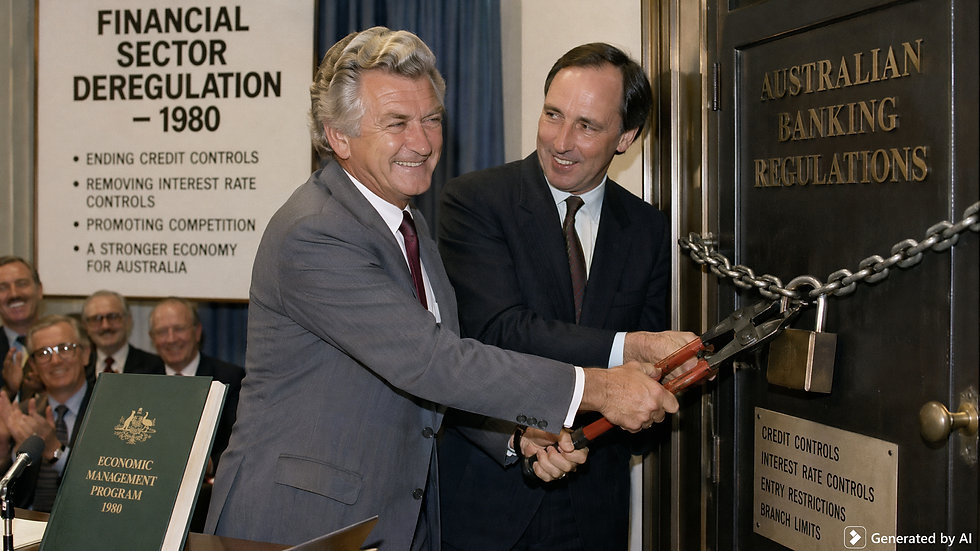
Image AI generated
These reforms aimed to boost competitiveness, address balance-of-payments issues, and integrate Australia into the global (especially Asian) economy. Exports + imports as a share of GDP rose significantly, and the changes are credited with laying foundations for decades of growth, though they also brought adjustment pains for protected industries and workers.
This was part of a broader global trend toward liberalization in the 1980s–90s, but it represented a departure from traditional Labor protectionism—driven by figures like Hawke, Keating, and John Button.
### Liberal Party and Menzies' Core Principles
**Sir Robert Menzies** founded the modern Liberal Party in 1944–45 as a non-socialist alternative emphasizing individual freedom, private enterprise, the "forgotten people" (middle class), rule of law, anti-communism, and a mixed but not heavily interventionist economy.
Menzies' philosophy (e.g., in *The Forgotten People* broadcasts) stressed:
- Personal responsibility and opportunity over state control.
- Support for private enterprise and incentives for production.
- Social security balanced with limited government.
- Patriotism, British heritage ties (evolving), and national cohesion.
- Opposition to socialism and excessive bureaucracy.
Under Menzies (PM 1949–1966), the party presided over post-war growth with regulated elements (tariffs, centralized wages) but prioritized free enterprise against Labor's nationalization pushes (e.g., banks). Later leaders like Malcolm Fraser maintained high tariffs initially. The party shifted toward deregulation and free-market ideas in the 1970s–80s (influenced by the "New Right"), but in opposition during Hawke-Keating, and later in government under Howard, it largely continued or built on economic openness, privatization, and trade deals (e.g., with the US, China, Japan).
Critics argue the modern Liberal Party drifted from Menzies' "small-l liberal" roots toward technocratic managerialism, multiculturalism as official policy (adopted under Fraser), large-scale immigration without sufficient emphasis on assimilation, globalist commitments (e.g., Paris Agreement, international institutions), and social/cultural shifts prioritizing identity politics or expert-driven governance over individual liberty and national cohesion. Some see this as abandoning the middle-class focus and patriotic skepticism of big government or supranational influences.
### Shift Away from Liberals and Rise of One Nation
Voters and some politicians have moved toward **Pauline Hanson's One Nation** due to perceived failures on:
- **Immigration and housing**: High migration levels exacerbating shortages and infrastructure strain.
- **Economic nationalism**: Concerns over foreign ownership, job offshoring, and globalization's impacts on regional/rural Australia and manufacturing.
- **Cultural and social issues**: Opposition to multiculturalism policies seen as eroding national identity, "woke" policies, and elite disconnect.
- **Cost of living, energy, and climate**: Skepticism of net-zero targets and renewable focus amid rising prices.
- Broader frustration with major parties' convergence on globalization, technocracy, and failure to prioritize "everyday Australians."
One Nation has surged in polls (reaching high teens to ~28% in some 2026 readings), drawing heavily from former Liberal/National voters, especially in regions.
**Barnaby Joyce**, former Nationals leader and Deputy PM (multiple times), defected to One Nation in late 2025, citing alignment and criticizing the Liberals' loss of economic conviction. He has taken roles like treasury spokesperson in the party.
This reflects dissatisfaction with the Coalition's direction post-2025 election loss.
### Is One Nation the "True" Australian Conservative Party?
This is a value-laden claim, not an objective fact. One Nation positions itself as **economic nationalist/protectionist**, socially conservative, anti-globalist on certain issues (e.g., strong borders, skepticism of international climate pacts, opposition to foreign land ownership), and focused on Australian sovereignty and "Australia First." It appeals to traditional conservative themes like patriotism, cultural cohesion, and protecting local industry/workers—echoing elements of pre-1980s Australian settlement politics.
Menzies emphasized anti-socialism and individual enterprise, which aligns more with classical liberalism than One Nation's protectionism. However, some analysts (e.g., IPA) argue Menzies would today favor One Nation's resistance to multiculturalism, technocracy, and cultural deregulation over the modern Liberals.
**Truth-seeking perspective**: Australian conservatism has always blended liberal economics with national/cultural conservatism. The Liberals evolved with globalization (benefiting overall growth but creating winners/losers). One Nation fills a populist niche on the right by prioritizing sovereignty and identity amid voter concerns about rapid change. Whether it is the "true" heir depends on one's definition of conservatism—economic openness and alliances vs. cultural/economic nationalism. Major parties' convergence created space for it, but One Nation remains polarizing and has faced internal issues historically.
Politics reflects trade-offs: Hawke-Keating reforms modernized the economy but contributed to de-industrialization pressures. Voter shifts signal demand for policies balancing global engagement with national interests. Outcomes will depend on elections and governance realities. **Technocracy** is a system of governance (or a style of decision-making) where **experts** — typically scientists, economists, engineers, bureaucrats, or specialists with technical knowledge — hold significant power or influence over policy, rather than elected politicians or the general public.
### Core Idea
- Decisions are driven by **evidence, data, efficiency, and scientific/instrumental rationality** ("what works best" according to experts), not primarily by ideology, popular opinion, tradition, or political bargaining.
- Legitimacy comes from **expertise and competence**, not votes or democratic consent.
- It contrasts with:
- **Democracy**: Rule by the people (or their elected representatives).
- **Populism**: Emphasis on the "will of the people" against elites.
- Traditional politics: Value-based debates, compromise, and accountability to voters.
_____________________________________________________________ What is Technocracy ?
In practice, pure technocracy (experts ruling outright) is rare. More common is **technocratic governance** within democracies: heavy reliance on unelected officials, advisory bodies, central banks, regulators, or international experts (e.g., in monetary policy, public health, climate, or economic regulation).
### Pros (as argued by supporters)
- More rational, long-term, and effective solutions to complex problems (e.g., pandemics, economic crises, infrastructure).
- Reduces short-term political pandering, corruption, or ignorance.
- Examples: Singapore's meritocratic, expert-heavy system; independent central banks like the RBA or Fed setting interest rates based on models; or COVID policy heavily guided by health experts.
### Cons and Criticisms
- **Undemocratic**:
Insulates decisions from public accountability. Experts can be wrong, biased (ideologically or by funding), or disconnected from everyday impacts.
- **De-politicizes politics**:
Treats value-laden choices (e.g., trade-offs between economy and environment, or national sovereignty vs. global rules) as purely technical.
- **Elite capture**: Creates a self-reinforcing class of technocrats who prioritize their paradigms (e.g., globalization, net-zero timelines, multiculturalism metrics) over voter concerns like cultural change, housing, or job security.
- Can lead to overconfidence ("scientism") and backlash when policies fail or ignore trade-offs.
### In the Australian Political Context
In discussions around the Liberal Party's evolution (from Menzies' era), critics use "technocratic managerialism" to describe a shift toward:
- Relying on expert panels, international agreements, bureaucratic processes, and economic models over traditional conservative instincts (national interest, skepticism of big changes, middle-class priorities).
- Policies seen as top-down and globalist (e.g., high immigration targets justified by economic modeling, climate commitments, or regulatory frameworks) that feel imposed rather than debated democratically.
This fuels support for parties like One Nation, which position themselves against "elites and experts" in favor of populist/nationalist priorities. It's part of a broader global tension between technocratic liberalism and populist conservatism.
Technocracy isn't inherently left or right — it can serve any ideology if experts align with it — but it's often criticized when it overrides voter preferences on contentious issues. In reality, modern governments blend elements of all these approaches.


