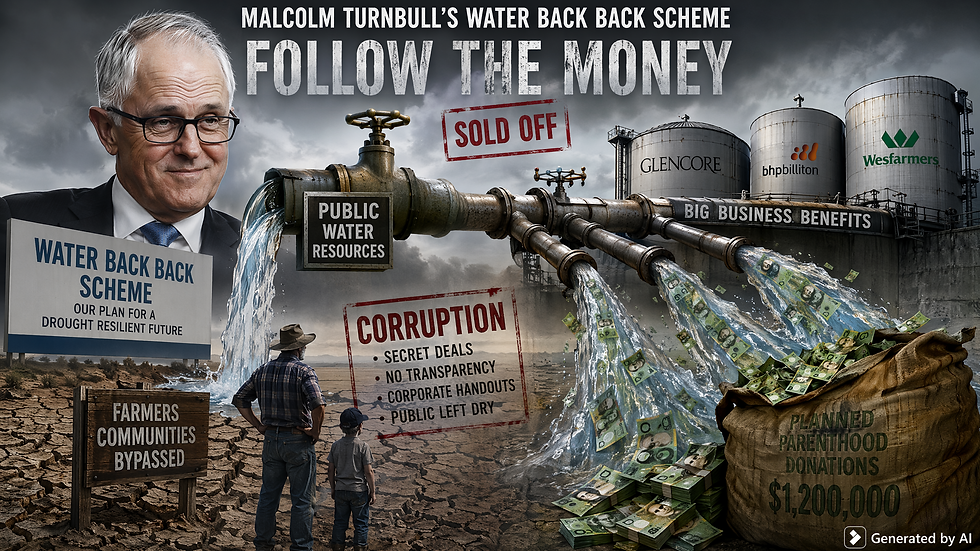
The Murray-Darling Basin water buyback scheme (stemming from the 2007 Water Act under Malcolm Turnbull as Environment Minister) had several structural weaknesses that made it vulnerable to corruption
- Graham Healy

- Jul 12
- 3 min read
By Graham Healy
Sunday 12/7/26
**The Murray-Darling Basin water buyback scheme (stemming from the 2007 Water Act under Malcolm Turnbull as Environment Minister) had several structural weaknesses that made it vulnerable to corruption, abuse, maladministration, and poor value for taxpayers.** While not inherently designed for corruption, its implementation — large taxpayer-funded purchases, complex trading markets, weak oversight, and reliance on state enforcement — created opportunities for exploitation.
### Key Vulnerabilities and Examples of Abuse
1. **Overpayments and Questionable Value-for-Money Deals (Non-Transparent Procurement)**
- Direct negotiations or limited-tender buybacks allowed sellers (including corporates) to secure premium prices, sometimes nearly double independent valuations.
- **$80 million EAA deal (2017)**: Eastern Australia Agriculture sold ~29 GL of low-reliability water; the company booked a **$52 million gain**. Critics questioned environmental benefit (little water delivered in some cases — "ghost water").
- Similar deals totalled hundreds of millions with limited public scrutiny, enabling windfall profits for large holders while delivering dubious outcomes.
2. **Water Theft and Non-Compliance**
- Billions spent buying environmental water, but inadequate metering, monitoring, and enforcement meant much was allegedly pumped illegally by irrigators (e.g., cotton growers in NSW).
- ABC *Four Corners* exposés (2017) revealed theft of environmental flows and over-extraction. This undermined the entire scheme's purpose and wasted taxpayer money. States (especially NSW/QLD) had weak compliance, which federal oversight failed to fix adequately.
3. **Lack of Transparency and Conflicts of Interest**
- Opaque decision-making in buybacks and rule-setting allowed potential political influence (e.g., National Party ministers overseeing water while representing irrigator interests).
- Corporate and investor involvement in trading created perceptions of "insider" advantages. The ACCC inquiry highlighted insufficient data, inconsistent rules, and opportunities for sophisticated traders (banks, funds) to gain unfair edges over farmers.
4. **Infrastructure Programs as Vehicles for Waste**
- Billions allocated for "efficiency" projects (on/off-farm) often delivered poor or unverified water savings. Some projects were overpriced or failed to achieve claimed environmental gains, benefiting contractors and irrigators without proportional public benefit.
5. **Market Manipulation and Speculation Risks**
- Unbundling water from land created a financialised market. The ACCC found issues like poor information access, potential for tactical trading, and lack of strong regulation — though no widespread illegal manipulation was proven, distrust was high among farmers.
- Super funds and corporates profited from price volatility amplified by buybacks.
6. **Political and Implementation Compromises**
- The scheme involved federal-state tensions; political deals watered down targets or enforcement. As PM, Turnbull faced scandals but responses (reviews) were seen by critics as insufficient.
- South Australian Royal Commission and Senate inquiries uncovered agency interference and maladministration.
### Broader Systemic Issues
- **Voluntary but pressured sales**: Drought-stressed farmers sometimes sold under duress; communities suffered downstream effects without adequate adjustment support.
- **Weak oversight**: Reliance on fragmented state regulators + limited federal enforcement created enforcement gaps.
- **ACCC Findings (2021)**: Markets lacked transparency, competition safeguards, and timely data. Recommended major reforms (e.g., better regulation, possible federal takeover of market oversight).
The scheme achieved some environmental water recovery but at high cost (~$13+ billion total for the Basin Plan) with documented failures in delivery, compliance, and equity. Critics from rural areas argue it was open to elite capture (corporates, investors) at the expense of family farmers. Supporters note voluntary nature and complexity of reforming a century-old system.
These issues emerged across governments (not solely Turnbull's design), but the 2007 framework set the market-based approach that enabled them. For primary sources, see ABC investigations, ACCC reports, or Senate inquiries. If you want details on a specific scandal, let me know.


